The computer software industry has become one of the most lucrative and fastest-growing career sectors worldwide. As businesses digitize operations, rely on data, and adopt artificial intelligence, the demand for skilled software professionals continues to rise.
Globally, the software industry employs millions of professionals and continues expanding rapidly. The United States alone has about 1.8 million software developers, and the number is projected to grow 25% by 2032, making it one of the fastest-growing occupations.
India has emerged as a global technology powerhouse with 4.3 million software engineers, representing 14.7% of the global developer workforce, and this number is expected to grow significantly in the coming years.
At the same time, companies are competing aggressively for specialists in emerging technologies such as artificial intelligence, cloud computing, cybersecurity, and big data. These specialties command some of the highest salaries in the entire technology industry.
Table of Contents
Why Are Software Engineering Jobs in Demand?
Software engineers are in high demand because technology has become essential in almost every industry—from finance and healthcare to transportation and entertainment. Several factors are driving this demand.
Digital Transformation: Companies worldwide are investing heavily in software systems to automate operations and improve efficiency.
Artificial Intelligence Adoption: AI technologies are transforming industries, creating massive demand for machine learning engineers and data scientists.
Global Talent Shortage: The global software industry faces a talent shortage of about 1.4 million workers, making skilled developers highly valuable.
Growth of Remote Work: Remote software jobs have increased dramatically, allowing companies to hire developers globally.
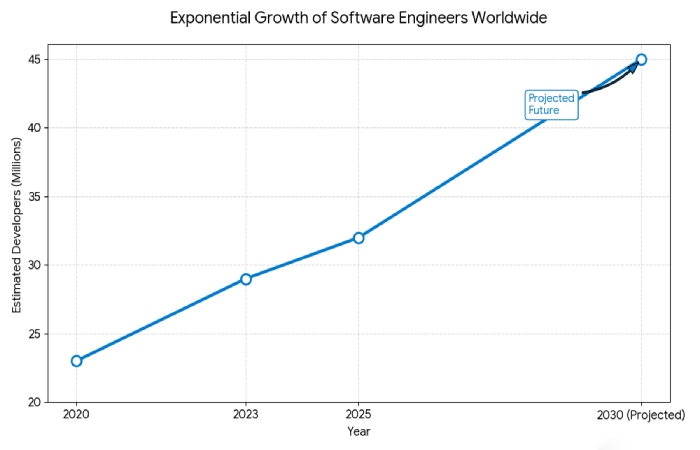
Growth of Software Engineers Worldwide
| Year | Estimated Developers Worldwide |
| 2020 | 23 million |
| 2023 | 29 million |
| 2025 | 32 million |
| 2030 (Projected) | 45 million |
Best Paying Jobs in Computer Software in India
The following table shows some of the highest-paying software careers in India, including salaries, required skills, tools used, and the estimated time to become proficient in the role.
| Job Role | Average Salary (India) | Key Skills | Popular Tools / Tech | Future Scope | Estimated Time to Become |
| Machine Learning Engineer | ₹15–40 LPA | Python, statistics, AI models | TensorFlow, PyTorch | Very High | 3–5 years |
| Cloud Solutions Architect | ₹25–45 LPA | Cloud computing, networking | AWS, Azure, GCP | Very High | 4–6 years |
| Data Scientist | ₹12–30 LPA | Data analysis, ML | Python, R, SQL | High | 3–5 years |
| Cybersecurity Engineer | ₹10–35 LPA | Security, cryptography | Kali Linux, Wireshark | Very High | 3–5 years |
| DevOps Engineer | ₹12–25 LPA | CI/CD, automation | Docker, Kubernetes | High | 2–4 years |
| Blockchain Developer | ₹10–30 LPA | Smart contracts | Solidity, Ethereum | Medium-High | 3–4 years |
| Big Data Engineer | ₹15–35 LPA | Data pipelines | Hadoop, Spark | High | 3–5 years |
| Full Stack Developer | ₹8–20 LPA | Web development | React, Node.js | High | 2–3 years |
AI-related roles currently offer the highest salaries because companies rely on machine learning systems for automation, prediction, and analytics. For example, deep learning engineers in India earn around ₹15–25 LPA, while specialists in natural language processing can earn even more.
Best Paying Jobs in Computer Software in Other Countries
Software salaries are typically higher in countries such as the United States, Canada, Germany, and Australia.
| Job Role | Average Salary (US) | Average Salary (UK) | Average Salary (Germany) |
| Machine Learning Engineer | $150K – $220K | £70K – £110K | €70K – €110K |
| Cloud Architect | $140K – $210K | £75K – £120K | €80K – €120K |
| Data Scientist | $130K – $200K | £65K – £100K | €65K – €95K |
| Security Engineer | $120K – $190K | £70K – £110K | €75K – €105K |
| DevOps Engineer | $115K – $180K | £65K – £95K | €70K – €95K |
| Software Architect | $150K – $220K | £80K – £120K | €85K – €130K |
Major tech companies are known to pay exceptionally high salaries. For example, salary filings show that some engineers at Microsoft earn up to $284,000 annually, with specialized AI roles earning even more.
Where Are These Services Available?
Software professionals work across multiple industries and sectors.
| Industry | Examples of Software Work |
| Technology | Software platforms, cloud services |
| Finance | Banking apps, trading systems |
| Healthcare | Medical software, AI diagnostics |
| E-commerce | Online shopping platforms |
| Gaming | Video game development |
| Automotive | Autonomous driving software |
| Education | EdTech platforms |
Software jobs are available globally in technology hubs such as:
- Silicon Valley (USA)
- Bangalore (India)
- London (UK)
- Berlin (Germany)
- Toronto (Canada)
- Singapore

What Are the Qualifications Required?
Most high-paying software jobs require a combination of education and practical skills.
| Qualification | Description |
| Bachelor’s Degree | Computer Science, IT, or Software Engineering |
| Certifications | AWS, Google Cloud, Kubernetes |
| Programming Knowledge | Python, Java, JavaScript |
| Portfolio Projects | Real-world applications |
| Internships | Industry experience |
In many cases, employers value skills and project experience more than formal degrees, especially in startups.
Why Some Software Jobs Pay Much More Than Others
Not all software jobs pay equally. Several factors determine salary levels.
Complexity of the Role: AI engineers and cloud architects handle complex systems that require deep technical expertise.
Business Impact: Roles that directly influence company revenue tend to offer higher compensation.
Talent Scarcity: Some skills are rare, making specialists more valuable.
Demand for Emerging Technologies: Fields like AI and cybersecurity are experiencing explosive growth.
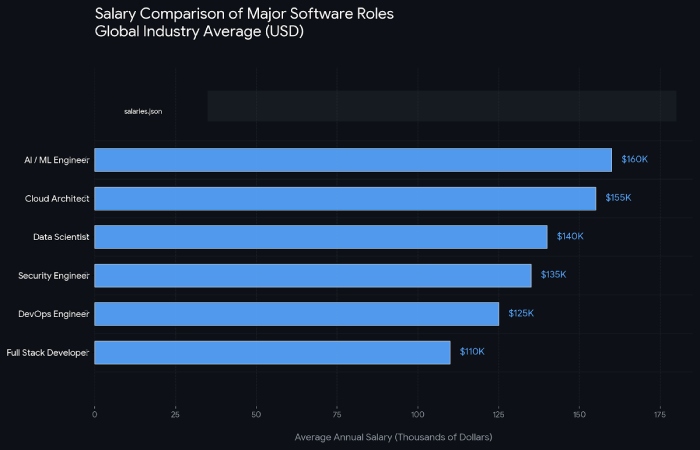
Salary Comparison of Major Software Roles
| Role | Average Global Salary |
| AI / ML Engineer | $160K |
| Cloud Architect | $155K |
| Data Scientist | $140K |
| Security Engineer | $135K |
| DevOps Engineer | $125K |
| Full Stack Developer | $110K |
Highest-Paying Skills in Software Engineering
Some technical skills command significantly higher salaries. According to job-market analysis, Python, AWS, SQL, and Kubernetes are among the most in-demand skills for software professionals today.
| Skill | Why It Pays Well |
| Artificial Intelligence | Used in automation and analytics |
| Cloud Computing | Critical for scalable infrastructure |
| Cybersecurity | Protects digital assets |
| Data Engineering | Handles massive datasets |
| Distributed Systems | Power large platforms |
Best Paying Companies for Software Engineers
Some companies are known for offering top salaries and benefits to software engineers. India also hosts thousands of Global Capability Centers (GCCs) where multinational companies hire software engineers to develop global products.
| Company | Headquarters | Why They Pay Well |
| USA | AI and cloud research | |
| Microsoft | USA | Enterprise software |
| Amazon | USA | Cloud computing (AWS) |
| Meta | USA | Social media platforms |
| Apple | USA | Consumer technology |
| TCS | India | Large IT services provider |
| Infosys | India | Global consulting |
| HCLTech | India | Technology services |
How to Land a High-Paying Software Job
Landing a high-salary software role requires strategic preparation.
- Choose the Right Specialization: Focus on fields such as AI, cloud computing, and cybersecurity.
2. Build a Portfolio: Create projects demonstrating your coding skills.
3. Contribute to Open Source: Participating in open-source projects increases credibility.
4. Gain Certifications: Cloud certifications significantly improve job prospects.
Real Secret to High Salaries in Software
Many beginners believe that learning multiple programming languages guarantees a high salary.
However, experienced professionals know that specialization is more valuable than general coding skills.
High-income developers usually focus on:
- AI engineering
- distributed systems
- large-scale data platforms
- infrastructure architecture
These areas power the core systems of modern companies.
Comparison of Popular Software Careers
| Career | Difficulty | Salary Potential | Demand |
| Software Developer | Medium | High | High |
| Machine Learning Engineer | High | Very High | Very High |
| Data Scientist | Medium-High | High | High |
| Cybersecurity Engineer | High | Very High | Very High |
| DevOps Engineer | Medium-High | High | High |
Review: Is a Software Career Worth It?
A career in computer software offers several advantages:
Pros
- High salaries
- Global job opportunities
- Remote work options
- Strong career growth
Cons
- Constant learning required
- Competitive job market
- Long working hours in some companies
Despite these challenges, software engineering remains one of the most rewarding professions.
Conclusion
The software industry continues to grow rapidly as businesses worldwide depend on technology to operate and innovate. Roles in artificial intelligence, cloud computing, data science, and cybersecurity are among the best-paying jobs in computer software today.
For beginners, the key to success is choosing the right specialization, building strong technical skills, and gaining real-world project experience.
With the right combination of knowledge, experience, and specialization, a career in software engineering can provide high salaries, global opportunities, and long-term job security.
FAQs
What is the highest-paying job in computer software?
Machine learning engineers, cloud architects, and AI specialists are among the highest-paying roles.
Which country pays software engineers the most?
The United States, Switzerland, and Canada typically offer the highest salaries.
What degree is best for software engineering?
A degree in Computer Science, Information Technology, or Software Engineering is most common.
Can I become a software engineer without a degree?
Yes. Many developers enter the industry through coding bootcamps and self-learning.
How long does it take to become a software engineer?
Typically 2–4 years, depending on education, projects, and experience.